What is the main reason for German Football’s decline in Europe this season?
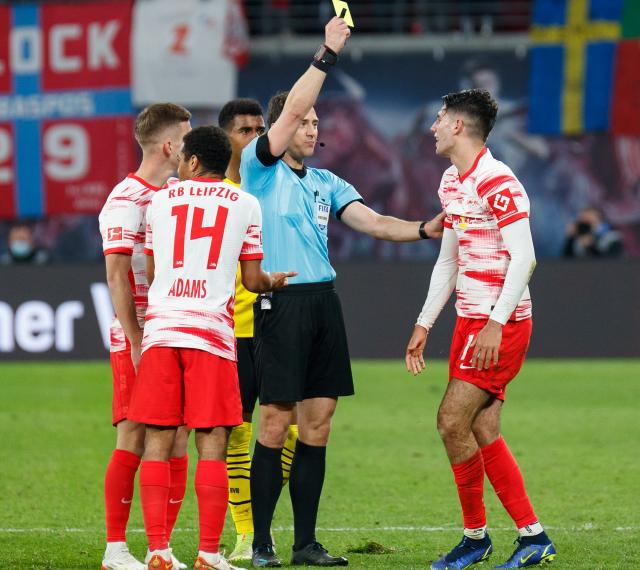
| Dominik Szoboszlai is shown a yellow card. | Photo: Steffen Prößdorf, CC BY-SA 4.0 |
For the first since 2017, only one German club qualified for the knockout stages of the UEFA Champions League.
With Germany picking up just the 6th most coefficient points this season - behind England, France, Italy, Spain, and even the Netherlands - clearly something is not right at the top of the Bundesliga. Putting the finger on just one aspect of the equation fails to sum up the full scale of the problem, so to get us closer to a satisfactory answer I've taken into account a wide range of factors.
A Summer of Change
Probably the most glaring aspect which has hampered Germany’s progress this season is the managerial overhaul which took hold over the summer.
Of the 6 German teams who qualified for this year’s Europa or Champions league, not a single one opted to hold onto their head coach from the previous campaign.
Comparatively, the other 24 clubs from Europe’s top 5 leagues combined for just 7 new appointments.
With all 6 clubs undergoing intensive rebuilds, international form has notably suffered.
RB Leipzig and VFL Wolfsburg are the most obvious examples, bowing out of the UCL group stage, and ending the Bundesliga Hinrunde with up to 13 fewer points than they had at the same stage last season, but even Borussia Dortmund have notably struggled to adapt to the demands of Marco Rose's style.
After dropping down from the Champions League, Rose's side crashed out of Europe altogether after failing to overcome a Rangers side whose combined value was almost €20m less than that of Erling Haaland.
One can only imagine the different prospects these three clubs would have had, had they entered the UEFA Champions League with their previous manager, or been afforded more time to gel with the demands of an entirely new system.
A Crisis of Identity
Whereas all the other European Leagues have had different champions in each of the last two seasons, one needs to go all the way back to 2012 to find the last time another German side pipped Bayern to the title.
Inevitably, it’s created a crisis of identity for German clubs, with the likes of Borussia Dortmund, Bayer Leverkusen, and RB Leipzig uninterested in spending exorbitant fees on established stars who are unlikely to shift the power dynamic, and present little resale value in 2-3 years.
This complete monopoly on the domestic honours has seen the Bundesliga’s other 17 clubs focus more on providing a platform for young talent. It's a lucrative model for long-term progression, but also one which, in the short-term, has made Germany less competitive on the international circuit.
In a recent interview with The Athletic, Borussia Dortmund's managing director Carsten Cramer hit the nail on the head,
“It’s part of our DNA. We won’t be able to sign the big stars, but we will educate them. Everyone knows that it’s the only alternative to be competitive. We don’t have much money, we are not owned by an investor or a government like some Premier League clubs. So we have to be creative.”
Only when a club like Dortmund combines their astute talent identification with an attractive model for players entering their prime will we see Germany make the next step as an international force.
The Plight of the Established Elite
There’s a reason I’ve heralded the Zweite Bundesliga as the greatest second division of all time. With Schalke 04, Werder Bremen, and Hamburger SV, German football fans are getting to see some of the most historic clubs in the country battle it out for topflight promotion.
It’s pure, unmatched, excitement, but it’s also undoubtedly hurting the nation’s European performance to see clubs of such a strong status wallowing away in the lower tiers. Without exorbitant ownership models which Premier League clubs can fall back on in hard times, even the biggest clubs in German football can find themselves spiralling from the European places to a relegation battle within a couple of years of boardroom mismanagement.
The likes of Union Berlin, SC Freiburg, or Mainz 05 all deserve a spot in the sun for their smart management, and long-term planning, but one can only imagine what a club of Bremen or Schalke’s stature could become if they married their impressive fan base and strong regional sponsorship, with the intelligent decision-making often exclusively found in some of Germany’s smallest topflight outfits.
Enjoy Adam Khan’s German Football Coverage? Then why not subscribe to his free Newsletter covering new content in the Bundesliga & Bundesliga 2 every Friday!
