Technical skills in soccer: What they are and how statistics measure them
Advertisement
Modern soccer has evolved so much since its first rules were codified in the late 19th century. It started as a simple game of chasing the ball and scoring goals, and it grew into a game of tactics, spatial awareness, and both physical and mental endurance.
However, even though this game has become more about smarts and tactics than about raw talent, technical skills in soccer are still indispensable. If you want to learn more about different soccer techniques, skills, and stats that measure them, keep reading this article!

What Are Technical Skills in Soccer?
Soccer technical skills are players’ physical capabilities to control and manipulate the ball with their feet, thighs, chest, and heads. Each player has a unique soccer technique, which takes years of hard experience and practice.
We need to distinguish technical from physical skills. The latter are more about strength, stamina, running speed, etc. There are also tactical skills that include decision-making, planning, and positioning.
For example, a player running after the ball for 90 minutes has good physical stamina. His technical skills have helped him pass the ball to his teammates multiple times and with high pass accuracy. Thanks to his tactical skills, he knew where to pass the ball and how it would progress the game further.
The Most Important Technical Skills in Soccer
These are the most important technical skills in soccer:
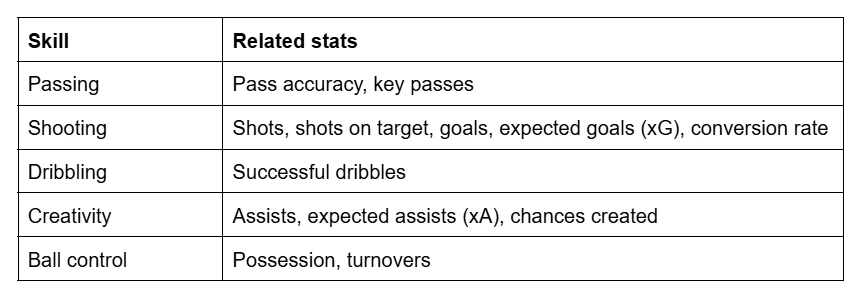
- Passing: This skill allows the team to play as one, from defense to midfielders and strikers.
- Shooting: A technical skill that allows players to make precise shots toward the opponent’s goal.
- Dribbling: Players need to be able to navigate tight spaces between opponents’ players, change directions, avoid interceptions, and lead the ball across the pitch.
- Creativity: The ability to perform high-risk, unexpected maneuvers that break the opponent’s defense and help the teammates score the goal.
- Ball control: A player’s ability to perform successful tackles and interceptions in order to disrupt the opponent’s attack.

Which Soccer Statistics Reflect Technical Skills?
Soccer stats, including both player statistics and match statistics, are a reflection of players' technical skills. These stats allow us to quantify and measure what’s happening on the pitch:
 These stats are no longer reserved for soccer experts, coaches, and managers. Regular sports fans can also find these stats on platforms such as 180Score. Such platforms offer AI-based insights, which can help fans conduct advanced soccer analytics on their own.
Benchmarks for Technical Skills Stats
The first step toward understanding stats and metrics is figuring out whether their values are average, below average, or above average. This way, you get a first impression of a player’s skills and how he utilizes them:
- Pass accuracy: The average is around 78-85%, above average is >88%, and below average is <75%, but it depends on the player’s position. Defense players usually have a higher pass accuracy on average.
- Key passes (per 90 minutes): The average is 1.2-1.8, above average >2.5, and below average <10.8
- Shots (per 90 minutes): The average is 2.2-3.2, above average >3.8, and below average <1.8
- Shots on target (per 90 minutes): The average is 0.8-1.4, above average >1.8, and below average <0.6
- xG (per 90 minutes): The average is 0.35-0.50, above average >0.65, and below average <0.25
- Successful dribbles (per 90 minutes): The average is 1.2-2.0, above average >3.0, and below average <0.8
Keep in mind that these benchmarks can vary depending on several factors, but these values can be a good starting point in evaluating technical skills. You’ll also need to consider the context…

Why Context Matters When Evaluating Technical Skills
When evaluating technical skills and techniques in soccer, you can’t just look at metrics and stats as they happen in a vacuum. You need to understand the context of these stats in order to properly make your evaluation. Only then will your match analysis provide some actual conclusions.
For example, let’s say there is a defensive midfielder in the team, and we want to evaluate his passing skill. We’ll do it via his pass completion rate, which is around 97%. That sounds like a lot, but the truth is, this player did a lot of short, lateral passes which didn’t do much for the team’s attacks and scoring.
Now, let’s take a look at a playmaker on the same team. His pass completion rate is only 70%, but many of his passes penetrated deeper into the opponent’s penalty area. So, even though he had fewer successful passes, they contributed more to the team’s scoring attempts.
This is why soccer stats, as a measurement of technical skills and player ratings, should be observed and analyzed as a part of a bigger picture, and not just on their own.
Conclusion
Technical skills and technique in soccer are still the driving force behind player performance and a team’s success. There are multiple stats that can help you evaluate players’ technique and conduct a deeper performance analysis, but you need to look at a wider picture, not just at numbers.
